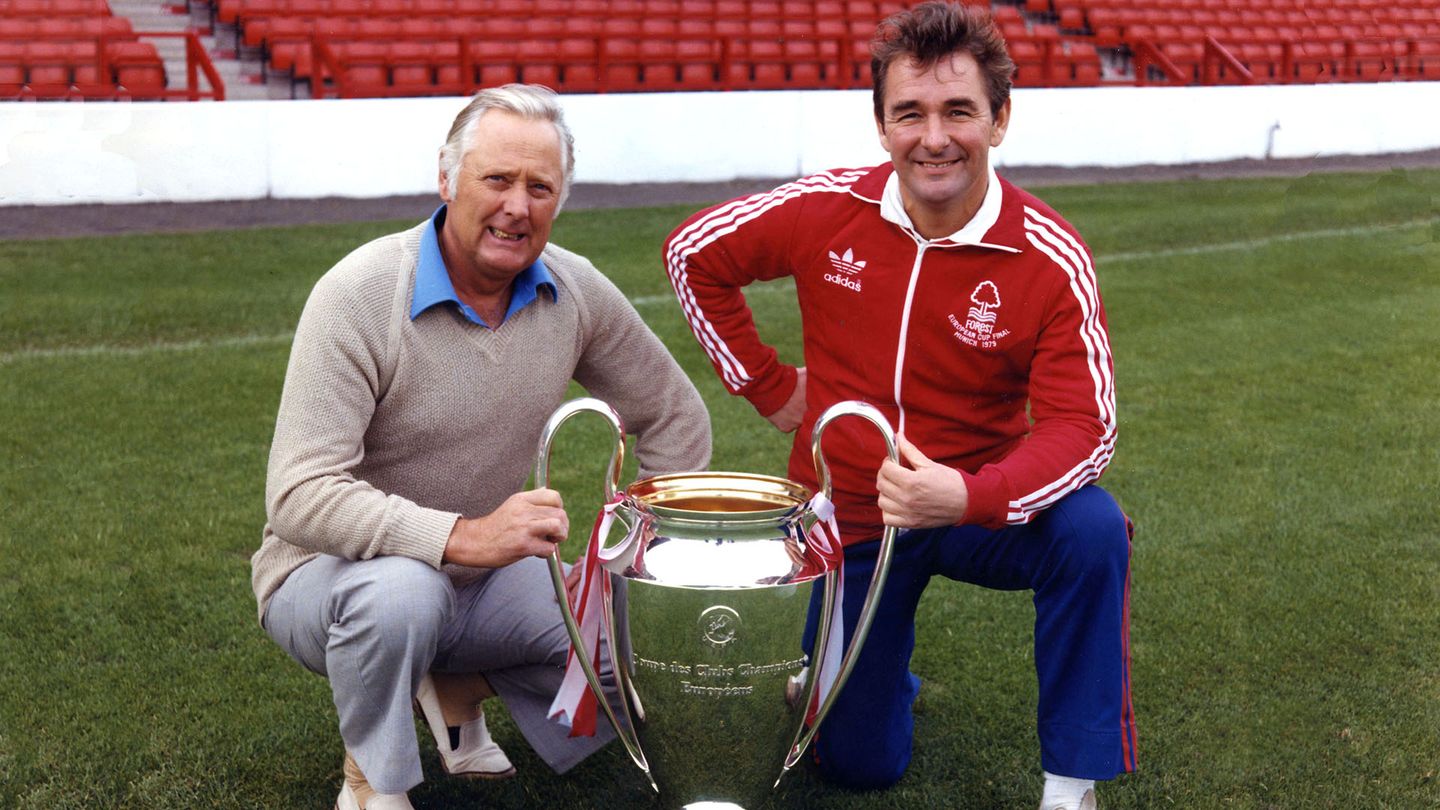
A small club at the top of Europe
Nottingham Forest were a Second Division club when Clough arrived on 6 January 1975. Within five years they had won the First Division (1978) and the European Cup twice (1979 and 1980). UEFA’s profile of Clough describes the achievement as one of the most remarkable in the competition’s history. Forest remain the only club to have won the European Cup more times than their domestic league title, a statistic that captures how far a provincial side travelled.
Football played on the ground
Clough’s teams were known for keeping the ball on the grass and passing it quickly, an approach he summed up with his often-quoted line that if God had wanted football played in the air he would have put grass in the sky. The emphasis was on simple, accurate passing, a disciplined back line and wide players such as John Robertson who could decide matches. It was not a revolutionary system on paper, but it was executed with unusual consistency.
Discipline and standards
Clough insisted on respect for referees and on good behaviour from his players. Forest’s players rarely surrounded officials, and Clough was quick to make examples of those who did. That standard became part of his reputation: success built on clear rules, short training sessions and a manager whose authority was unquestioned.
A partnership, not a lone genius
The Forest legacy belongs to Clough and Peter Taylor together. Taylor’s judgement of players, from Kenny Burns to Larry Lloyd, combined with Clough’s leadership. The 42-match unbeaten league run between November 1977 and December 1978 showed how well the pairing could build a team that rarely lost.
How the legacy is remembered
The City Ground’s Brian Clough Stand, the statues in Nottingham, Middlesbrough and Derby, and the Brian Clough Trophy contested by Derby and Forest keep his name in the places he changed. David Peace’s novel The Damned United and its 2009 film brought his story to a new audience, although both are fiction. For many supporters the lasting lesson is simpler: a well-organised team from a modest club could beat the best in Europe.