1,140 league matches, 505 wins and titles with two clubs: Clough’s managerial record, with the competition boundaries made clear.
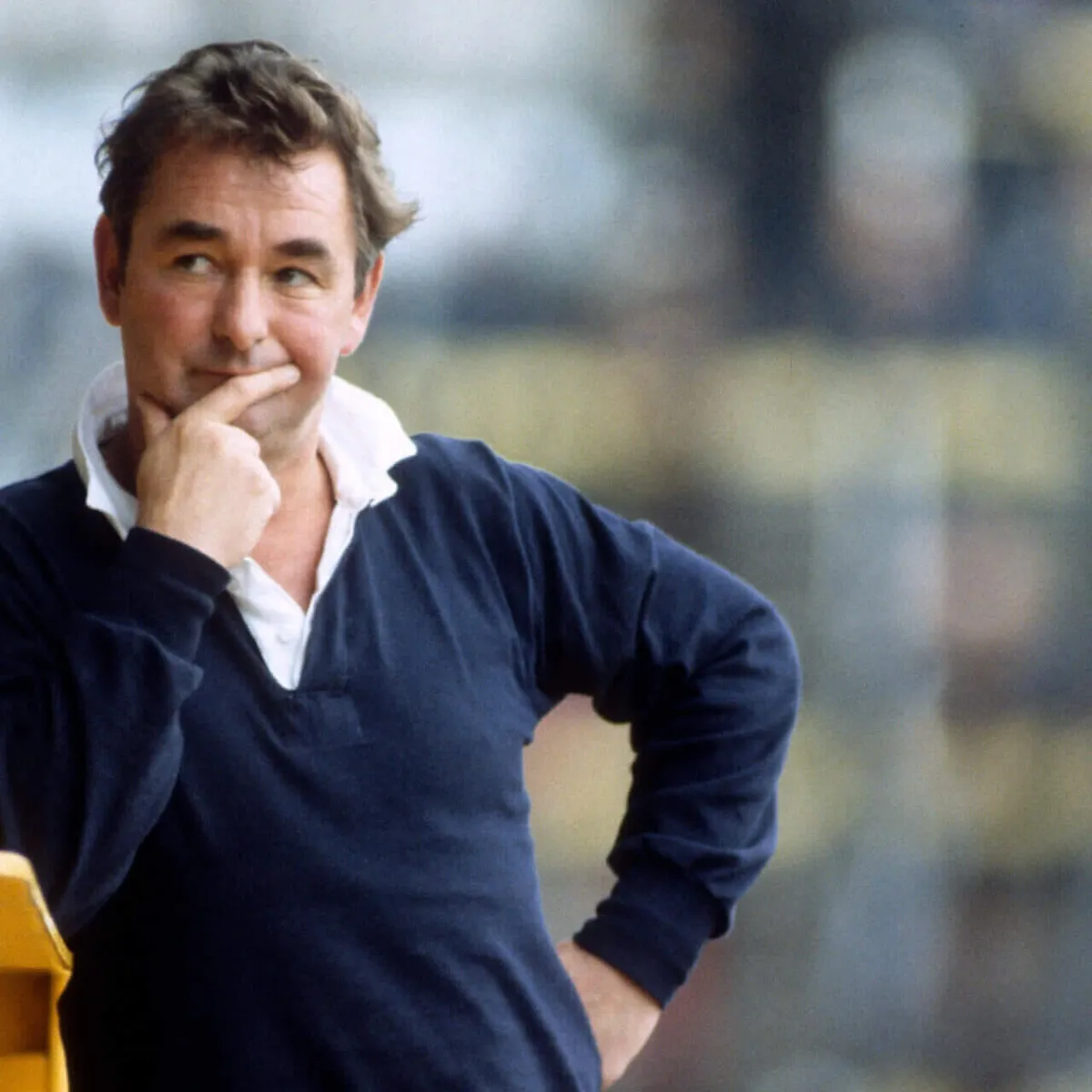
Brian Clough · portrait date unconfirmed.
The league record in full
The career record published by BrianClough.com lists 1,140 league matches as a manager: 505 wins, 291 draws and 344 defeats. His teams scored 1,678 goals and conceded 1,298. These are league totals across his managerial career, not a count of every competitive fixture and not his record at Nottingham Forest alone. Keeping that definition attached to the figures is essential: cup matches would change both the number of games and the balance of results.
What 505 wins means
Dividing 505 wins by 1,140 league matches gives a win rate of approximately 44.3 per cent. There were 796 matches in which his teams avoided defeat, combining wins and draws. These are calculations from the published league record, rather than separate historical claims. They describe a long career across different divisions, clubs and circumstances. They do not mean that every Clough team won at the same rate, or that a percentage alone can explain his reputation.
Five clubs, very different jobs
His management career ran from Hartlepools in 1965 to Nottingham Forest in 1993, with Derby County, Brighton and Leeds United between them. Hartlepools offered a beginning in the Fourth Division. Derby provided the first sustained demonstration that Clough and Peter Taylor could build a championship side. Brighton and Leeds were short and difficult chapters. Forest became the longest appointment and the setting for his European achievements. An overall total combines all of those jobs; it should not be presented as a single club’s record.
The titles behind the totals
Derby won the Second Division in 1969 and the English championship in 1972. Forest gained promotion in 1977 and won the First Division in 1978, their first season back in the top flight. Those two top-flight titles, achieved with different clubs, are a more specific statement of Clough’s impact than a general claim that he won often. His teams did not simply accumulate victories: two of them crossed the gap between the lower division and the summit of English football.
Why Europe needs its own column
Forest’s European Cups in 1979 and 1980 are not included in a league-only match total. Nor are their four League Cup wins in 1978, 1979, 1989 and 1990. The distinction is useful rather than pedantic. League records measure repeated performance over a season; knockout honours capture a different challenge. Clough’s reputation rests on both. Mixing the two into an unexplained total makes comparison harder and can turn a correct number into a misleading description.
Reading the difficult ending honestly
Clough’s final Forest season ended in relegation in 1993. That belongs in the record alongside the championships and European Cups. A career spanning nearly three decades contains changes of squad, form and circumstance; it cannot be reduced to either the greatest night or the last result. The league figures offer a useful starting point, while the club pages and chronological timeline explain where those results came from. The source below explicitly labels its figures as league matches.
An inherited core, Peter Taylor’s return and carefully chosen recruits: how a Second Division club became English and European champions.
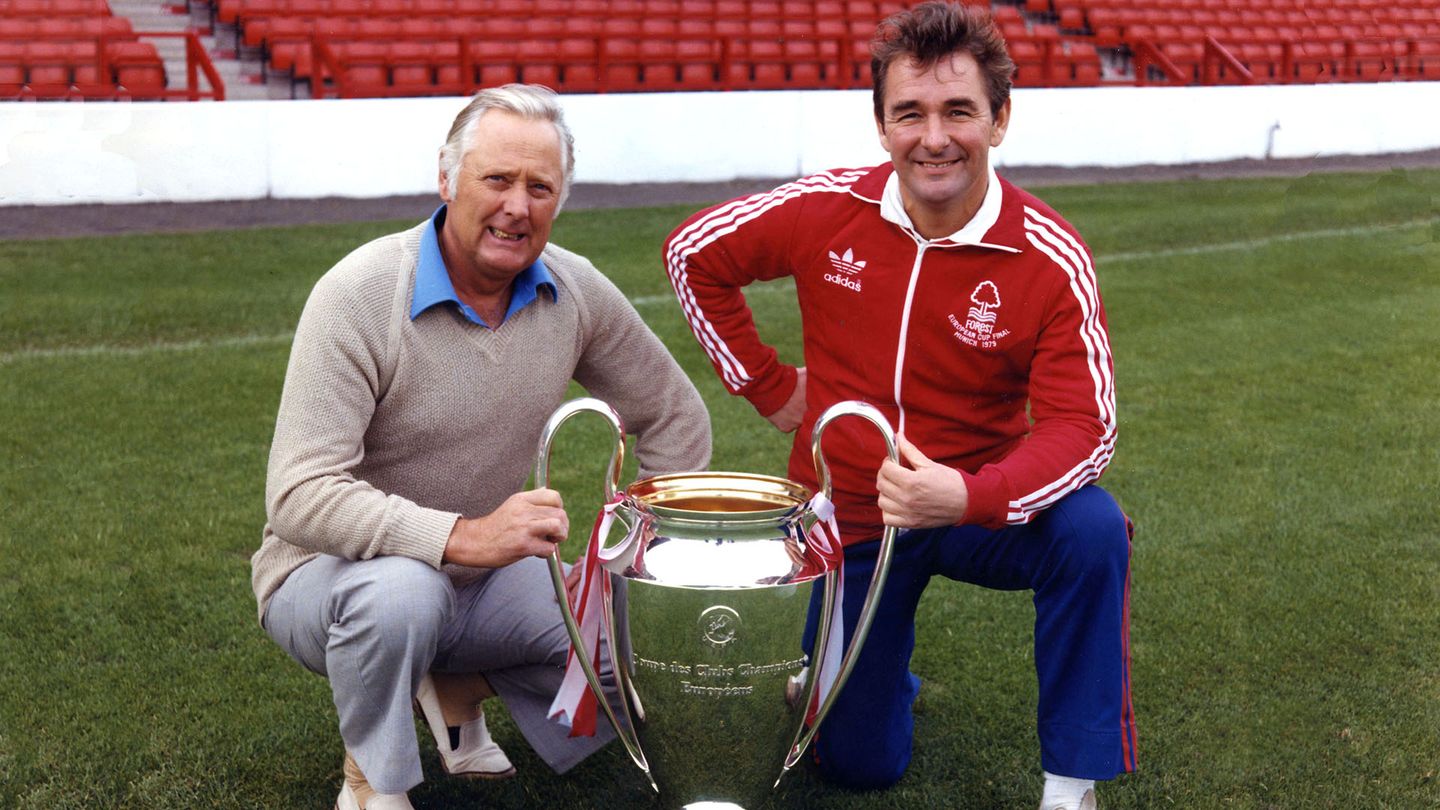
Clough and Taylor with the European Cup in 1979, after the team’s rise from the Second Division.
Start with the club he actually inherited
Forest’s board ratified Clough’s appointment on 6 January 1975. The club was in the Second Division, and his recent record included the unhappy spells at Brighton and Leeds. The BBC’s account of the appointment, published for its fiftieth anniversary, describes both the board’s apprehension and the transformation that followed. This was not an established champion hiring a manager to preserve its status. Forest gave Clough the opportunity to build again after a very public setback.
The core was not bought all at once
Martin O’Neill told the BBC that five players already at Forest when Clough arrived went on to share promotion, the English championship and the first European Cup. That is an important detail in a story often told through famous signings alone. Clough did not replace every inherited player with a ready-made champion. Part of the achievement was recognising that footballers in a Second Division squad could contribute at a much higher level when the team around them changed.
Peter Taylor’s return restored the partnership
Taylor joined Clough at Forest in 1976. Their previous work at Hartlepools and Derby had established the importance of the partnership: recruitment and judgement of players alongside leadership and organisation. Forest’s rise should not be described as the work of one man operating in isolation. Clough supplied the dominant public personality, but Taylor’s contribution belongs in any serious account of how the side was assembled. Promotion followed in the 1976–77 season.
Recruitment strengthened the spine
Peter Shilton arrived from Stoke and Kenny Burns from Birmingham in 1977. Shilton became the goalkeeper behind the league title and European victories; Burns, previously used as a forward, became a central defender in the champion side. These changes illustrate recruitment as more than collecting recognisable names. The relevant question was how a player would fit the team. Forest combined retained players with additions who strengthened positions essential to its defensive organisation and confidence.
Domestic success came before Munich
Forest won the English championship and the League Cup in 1978, immediately after promotion. The 42-match unbeaten league sequence demonstrated that the title was underpinned by consistency, not merely a brief run of favourable results. European competition then provided a new test. Trevor Francis, signed in 1979 as Britain’s first £1 million footballer, scored the winner against Malmö in the European Cup final. His goal was the conclusion of a team-building process already rewarded at home.
The second European Cup confirmed the achievement
John Robertson scored the only goal against Hamburg in Madrid in 1980 as Forest retained the European Cup. Two successive wins at that level made the transformation extraordinary even beyond the original league title. The chronology is worth keeping clear: Clough’s appointment in 1975, Taylor’s return in 1976, promotion in 1977, the English title in 1978, then European Cups in 1979 and 1980. The rise involved an inherited core, purposeful additions and a partnership whose contributions cannot be separated from the results.
From November 1977 to December 1978, Nottingham Forest went 42 league matches without defeat. The record behind Clough’s champions.
Clough and Taylor with the European Cup in 1979, after the unbeaten league run had ended. This is not a photograph of a match during the streak.
A record built across two seasons
Nottingham Forest’s 42-match unbeaten run was a First Division league record, not a claim that they never lost in any competition. It began with a 0–0 home draw against West Bromwich Albion on 26 November 1977 and ended with a 2–0 defeat at Liverpool on 9 December 1978. Between those dates, Brian Clough’s team completed the rest of one league season and carried their resistance deep into the next. The match-by-match records linked below establish the sequence.
The champions were newly promoted
Forest had returned to the First Division in 1977. Clough and Peter Taylor were not protecting the reputation of an established title-winning side: they were taking a newly promoted club into unfamiliar territory. The unbeaten sequence became part of the campaign that brought Forest the 1978 championship. It explains why that title was more than a brief burst of good form. Week after week, opponents failed to find a way to beat them.
Winning was only half the story
The run contained 21 wins and 21 draws. That balance matters. Forest did not sweep aside every opponent, and the record should not be retold as 42 victories. A draw preserved a point and kept a difficult afternoon from becoming a defeat. Their 4–0 win at Manchester United in December 1977 showed their attacking capacity; the goalless results elsewhere showed a different kind of resilience. Both belonged to the same achievement.
Where the record stopped
Liverpool finally ended the sequence at Anfield. Terry McDermott scored both goals in the 2–0 victory on 9 December 1978. By then the rivalry had already shaped several competitions: Forest had won the previous league title, beaten Liverpool in the League Cup final replay and eliminated them from the European Cup. Liverpool’s win was therefore more than the removal of an unbeaten record. It was a significant result against the team that had repeatedly obstructed them.
A league record, not an unbeaten calendar
It is important to keep the competition boundary clear. Forest could lose a cup tie without ending this league sequence. Likewise, winning a trophy did not add a match to the league total. The distinction makes the achievement easier to compare with later records and prevents a familiar statistic from becoming an exaggerated story. The 42 refers to consecutive top-flight league fixtures, spanning the 1977–78 and 1978–79 seasons.
Why it still belongs in Clough’s story
Arsenal eventually surpassed Forest’s mark in 2004 and extended their own league run to 49 matches. That did not erase what Clough’s side had achieved. Forest’s sequence connects promotion, the English championship and the beginning of their European adventure. The European Cups supply the most famous photographs, but this record captures the sustained domestic consistency that helped make those nights possible. Read the Forest career page for the wider story beyond the streak.
Forest won the League Cup under Clough in 1978, 1979, 1989 and 1990. Why those four trophies matter beyond the European Cup story.
Brian Clough · portrait date unconfirmed. This photograph is not identified as a League Cup occasion.
Four trophies, two different decades
Brian Clough won the League Cup four times as Nottingham Forest manager: in 1978, 1979, 1989 and 1990. The honours record is easy to overlook beside the two European Cups, but it changes the shape of his Forest story. Success was not confined to the team that rose from the Second Division in the late 1970s. Clough also brought major domestic silverware to the club more than a decade later.
1978: a trophy alongside the league title
The first League Cup arrived during Forest’s extraordinary first season back in the First Division. They overcame Liverpool in a final replay at Old Trafford and also won the English championship that spring. Liverpool were the leading domestic and European benchmark of the period, so beating them in a cup final added substance to Forest’s emergence. The league title and League Cup were distinct competitions, won by the same newly promoted side.
1979: retaining the League Cup
Forest won the competition again in 1979. That second successive League Cup sits in the same year as their first European Cup, but the honours should be counted separately. One was a domestic knockout trophy; the other was the championship of Europe. Together they show the demands placed on a side competing on several fronts. A season remembered for Trevor Francis’s winning header in Munich also contained another major cup success at home.
1989: the later Forest years mattered too
A decade after the second League Cup, Clough won it for a third time. The 1989 trophy is a useful corrective to accounts that jump straight from the European triumphs to his retirement. Forest’s later years were not simply an extended farewell to the original champions. Players and personnel changed, but the club could still turn a cup campaign into silverware. This later success belongs alongside the more frequently celebrated early achievements.
1990: another successful defence
Forest retained the League Cup in 1990, completing a second pair of consecutive wins under Clough. The symmetry is striking: 1978 and 1979, then 1989 and 1990. Those dates demonstrate longevity without suggesting that every season brought a trophy. They also keep the record precise. Clough’s four League Cups were all won with Forest; his earlier championship with Derby County belongs to a different club and a different competition.
What the honours tell us — and what they do not
A trophy list cannot explain every selection, training session or dressing-room relationship. It can, however, stop the biography becoming too narrow. Clough’s Forest record includes an English title, two European Cups and these four League Cups. The later victories show that his achievements continued beyond the famous partnership and photographs of the late 1970s. Our Forest page places the cups in the full eighteen-year chapter, including the difficult final season rather than ending the story at its peak.
Brian Clough died on 20 September 2004, aged 69. The facts about his final years, private funeral and public memorial.
Brian Clough · portrait date unconfirmed.
The date and age
Brian Clough died on 20 September 2004, aged 69. BBC reporting at the time identified stomach cancer as the cause of his death and reported that his family were with him at Derby City General Hospital.
The final years
Clough had retired from Nottingham Forest in 1993. His later life was affected by alcohol dependence and ill health. A liver transplant in January 2003 preceded his death the following year. These personal difficulties belong to his biography, but they are not a substitute for remembering the breadth of his life.
A private funeral, a public farewell
The private funeral took place in Derby on 7 October 2004. BBC coverage described a small ceremony for family and close friends. A separate memorial service at Derby Cathedral was arranged for 21 October, allowing the football world and the wider community to remember him.
Why his name endures
Clough’s record included 251 league goals as a player, English championships with Derby County and Nottingham Forest, and consecutive European Cups with Forest in 1979 and 1980. The stories of the players and supporters he affected explain why his name remains much more than a list of honours.
Brian Clough’s appointment was ratified on 6 January 1975. How a Second Division club became English and European champions.
Clough and Taylor with the European Cup in 1979 — four years after his appointment, not a photograph of his arrival.
6 January 1975: the appointment
Nottingham Forest’s board ratified Brian Clough’s appointment on 6 January 1975. BBC Sport’s 50th-anniversary account identifies that date as the beginning of the relationship that transformed the club. Forest were then in the Second Division, not an established European power.
Why the opportunity mattered
Clough had already won the English league with Derby County. His next chapters had been far less successful: a short spell at Brighton and 44 days at Leeds. Forest gave him another chance to build a team rather than inherit a reigning champion. Peter Taylor returned to work alongside him in 1976.
Promotion, then champions
Promotion followed in 1977. On 22 April 1978, Forest clinched the First Division title in their first season back in the top flight. They also won the League Cup that season, beating Liverpool in a replay. Clough and Taylor had turned a team expected to struggle into champions.
Munich and Madrid
Forest won the European Cup on 30 May 1979 when Trevor Francis scored against Malmö in Munich. On 28 May 1980, John Robertson’s goal against Hamburg in Madrid secured a second successive European Cup. Those victories are the clearest answer to why Clough’s appointment remains such a landmark.
An eighteen-year chapter
Clough remained at Forest until May 1993. Later League Cups and new generations of players widened the story beyond the celebrated team of the late 1970s. His final season ended in relegation, but the difficult ending does not diminish the scale of the transformation begun in January 1975.
Clough was the public’s choice in 1977, but the FA appointed Ron Greenwood. Why the greatest manager England never had was passed over.
Brian Clough · portrait date unconfirmed.
The people’s choice
When Don Revie left the England job in 1977, Clough had already won the league with Derby and was building Forest. Supporters and much of the press wanted him.
The interview
The Football Association interviewed Clough, but appointed Ron Greenwood..
Too outspoken to control
Clough had criticised football’s authorities for years. The usual explanation is that the FA feared he would run the national team on his own terms. Clough later agreed that he would have tried to take it over.
Read more
The full story is on our Clough and England page, and his club record is on the Manager page.
Peter Shilton, Trevor Francis, Kenny Burns, Dave Mackay and more: the signings that built Clough’s champion teams.
Clough and Taylor with the European Cup in 1979.
Dave Mackay (Derby, 1968)
Clough persuaded the veteran Tottenham captain to join Second Division Derby. Mackay’s experience led the side to promotion in 1969.
Roy McFarland (Derby, 1967)
Signed from Tranmere Rovers, McFarland became the centre-half at the heart of Derby’s 1972 title team and an England international.
Kenny Burns and Peter Shilton (Forest, 1977)
Burns arrived from Birmingham as a forward with a fiery reputation and was converted into a commanding centre-back. Shilton, signed from Stoke, became the goalkeeper behind Forest’s title and European Cups.
Trevor Francis (Forest, 1979)
Britain’s first £1 million footballer, Francis repaid the fee by heading the winning goal in the 1979 European Cup final against Malmö.
The eye of Peter Taylor
Many of these players were identified by Taylor, Clough’s assistant. Read more on our Peter Taylor and Greatest players pages.
Clough replaced Don Revie at champions Leeds in July 1974 and was sacked 44 days later. The facts behind football’s most famous short reign.
Brian Clough · date and occasion unconfirmed; not a photograph from Leeds.
Succeeding Don Revie
In July 1974 Don Revie left Leeds United, the reigning league champions, to manage England. Leeds appointed Clough, who had repeatedly criticised the club’s style of play while at Derby.
A difficult start
Clough arrived without Peter Taylor, who stayed at Brighton. His first competitive match was the 1974 Charity Shield against Liverpool at Wembley, remembered for the sendings-off of Billy Bremner and Kevin Keegan.
Results and the dressing room
Leeds won only one of their first six league matches. Relations with senior players were strained, and the board dismissed Clough on 12 September 1974, 44 days after his appointment.
What came next
Within four months Clough joined Nottingham Forest, where he went on to win the league and two European Cups. The Leeds episode later inspired David Peace’s novel The Damned United and the 2009 film.
Two Middlesbrough-born managers with opposite views of football. How the Clough–Revie rivalry shaped his time at Leeds.
Brian Clough · portrait date unconfirmed.
Shared roots
Both men were born in Middlesbrough and both became leading managers in the late 1960s and early 1970s: Revie at Leeds, Clough at Derby.
Opposing ideas
Clough publicly criticised the gamesmanship he associated with Revie’s Leeds. That history made his appointment as Revie’s successor in 1974 controversial from the start.
Face to face on television
On the day Clough left Leeds, the two men appeared together on Yorkshire Television’s Calendar programme, an interview still widely watched today. It is listed on our Press timeline.
Read more
The full Leeds story is on our 44 days page, and Clough’s wider record is on the Manager page.
Leeds met Liverpool at Wembley in August 1974. A brawl, two sendings-off and a penalty defeat set the tone for Clough’s brief reign.
Brian Clough · date and occasion unconfirmed; not a photograph from Wembley.
Champions against cup winners
The Charity Shield of August 1974 paired league champions Leeds with FA Cup winners Liverpool. It was Clough’s first competitive game as Leeds manager and the first Wembley Charity Shield.
Bremner and Keegan sent off
Billy Bremner and Kevin Keegan were dismissed after fighting and both threw their shirts to the ground as they left. The FA later handed them long suspensions.
Defeat on penalties
The match finished 1–1 and Liverpool won the shoot-out. For a manager trying to win over a sceptical squad, it was a difficult beginning.
David Peace’s 2006 novel and the 2009 film made Clough’s 44 days famous again. What is history, and what is imagined?
Brian Clough · portrait date unconfirmed.
A novel, not a biography
David Peace’s The Damned United (2006) tells the Leeds story through an imagined inner voice. The Clough family criticised the portrayal, and Johnny Giles took legal action over how he was depicted; the publisher settled.
The 2009 film
Michael Sheen played Clough and Timothy Spall played Peter Taylor in Tom Hooper’s film. It added scenes and compressed events for drama.
What is certain
Clough succeeded Don Revie in July 1974, results were poor, and the board dismissed him on 12 September 1974 after 44 days. Our 44 days page sets out the record.
Brian Clough scored 251 league goals but won only two England caps, against Wales and Sweden in October 1959. Here is the story of both games.
Brian Clough · date and occasion unconfirmed; not an England match photograph.
A striker England could not ignore
By 1959 Brian Clough was one of the most prolific forwards in the country, scoring around 40 league goals a season for Middlesbrough. He was doing it in the Second Division, though, and in an era when England picked mostly First Division players, that counted against him.
Cap one: Wales at Ninian Park, 17 October 1959
Walter Winterbottom finally called him up for the Home Championship match against Wales in Cardiff. The game ended 1–1, and Clough did not score.
Cap two: Sweden at Wembley, 28 October 1959
Eleven days later he kept his place for a friendly against Sweden at Wembley. England lost 3–2, again without a goal from Clough, and he was never picked again.
Why only two?
England had established forwards, Clough was outside the top flight, and two quiet games were enough for the selectors to look elsewhere. His move to Sunderland in 1961 kept the goals coming, but the knee injury of December 1962 ended any chance of a recall.
What it meant to him
Two caps for a player who finished with 251 league goals is one of English football’s great oddities. Clough’s later frustration with the FA, including his failed interview for the manager’s job in 1977, gave the story a long tail.
Read more
The full story, including the 1977 interview, is on our Clough and England page.